












Monday morning usually gives me two kinds of work.
Some of it is clean: send the follow-up, review the draft, fix the invoice note, book the appointment. Tasks like that have edges. They can sit on a day and behave.
The other kind is “think through pricing,” “make progress on the deck,” “figure out what to do with the client feedback,” “Mark loose end.” That work is just as real, but it is too important to forget and too vague to schedule. A calendar block is the wrong home for it, and so is a giant someday list where it would quietly age into furniture.
Slate came from that exact mess. I wanted a way to plan a week before I fully understood it, without pretending I had more information than I did.
The week will not explain itself on Monday
Most weekly-planning advice assumes the week is knowable: list your priorities, block your time, assign your tasks, then start Monday as if the next five days had agreed to cooperate. A client answers the wrong question, a small task turns out to have three dependencies underneath, a meeting moves into the one clean stretch of the day, and the Friday emergency may look like a minor thing by Tuesday. None of that means the plan lacked discipline; knowledge work simply behaves this way.
So I have stopped asking a weekly plan to predict anything. I ask it for a shape before the noise arrives, and twenty minutes covers that, because the first plan only needs to be a working draft the week is allowed to revise.
Start with the rough material
I do not start with the calendar. The calendar already knows the hard things, the calls and travel and appointments that become awkward if missed, so I check it and move on. The week begins in the Idea Backlog, where the rough material has been collecting: captured thoughts, half-tasks, notes to self, things I was not ready to decide about when they first appeared.
Most weeks the right plan is already in that pile. It just has not been carved yet, and carving means deciding what deserves the week rather than promoting everything into a commitment.
A twenty-minute weekly planning ritual
The version I want Slate to support is four passes, five minutes each.
1. Empty
Put down in your backlog whatever is still in your head. Do not organize it or improve the wording, and do not ask yet whether any of it is important. “Ask Lena about numbers.” “Renew thing.” “Maybe rewrite intro around calendar/list point.” “Mark???” All fine. Holding rough material is what the Idea Backlog is for.
Your brain will keep serving up the same thought at useless times until it has somewhere else to live, because storage was never its job. Spend the five minutes emptying the pockets.
2. Sort
Now look at what is there. Some of it is still alive, some has gone stale, and some was a good idea in a mood I no longer recognize. Delete whatever is quietly dead. This is harder than it sounds, because deleting a task feels like an admission, and it is one; that is exactly why it works. A plan often improves more by subtraction than by placement. “Maybe redesign invoices” may belong to a different season, and “read strategy article” can go once I no longer remember why I saved it.
Then rename the vague items that are still real. “Mark???” becomes “Ask Mark whether the draft needs legal review.” If I cannot tell what a task means when I read it back, it is not ready to be given a day.
3. Carve
Drag the ready work into the weekly slate. Because this is the visible part, people mistake it for the whole act of planning, when it is only the cut at the end.

Put each task on the day where it has the best chance of happening, which is rarely the earliest day and never the one that merely performs optimism. Monday is usually worse than it looks: Friday debris, Sunday optimism, and at least one meeting that creates work while pretending to resolve it. Tuesday can hold more, Wednesday tends to tell the truth, and Thursday can take the task you postponed honestly. Friday deserves better than landfill duty. Six useful tasks across a week beat twenty-two ornamental ones.
4. Leave room
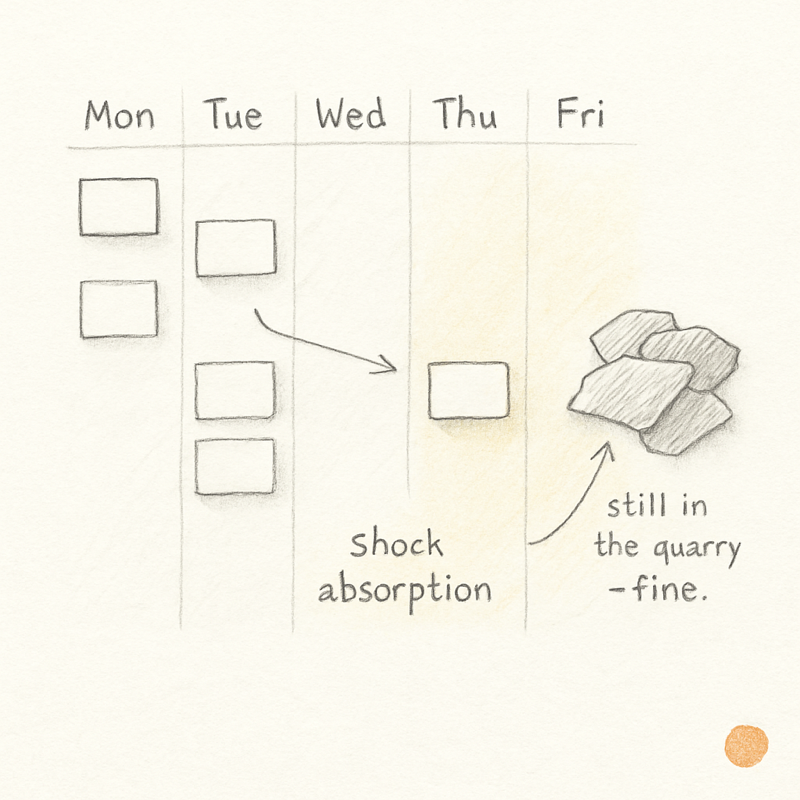
This pass is the one that saves the plan: leave one day light and keep gaps around tasks that look simple, so the week you did not predict has somewhere to land.
Most plans fail because they are full on Monday. A full plan looks decisive, but much of the time it is just avoiding ambiguity, and the ambiguity arrives either way. When there is no room, the week makes room by force: one task slides into the evening, then into tomorrow, then into that pile of tasks I avoid because they have started to feel like evidence. The nearly empty day is the shock absorber.
Mid-week resets are allowed
People treat replanning as proof that the original plan failed, when it is often proof the plan is being used. On Wednesday I move work around, empty out the new thoughts, and release the task that has become silly. If the week has opened a door, I pull an item up from the Idea Backlog; if something was never really ready, I push it back. The Friday version of me had partial information and suspicious enthusiasm, and I do not treat his plan as a contract.
After twenty minutes I have a shape for the week, a pile of material, some open space, and no certainty about any of it, but that is OK.